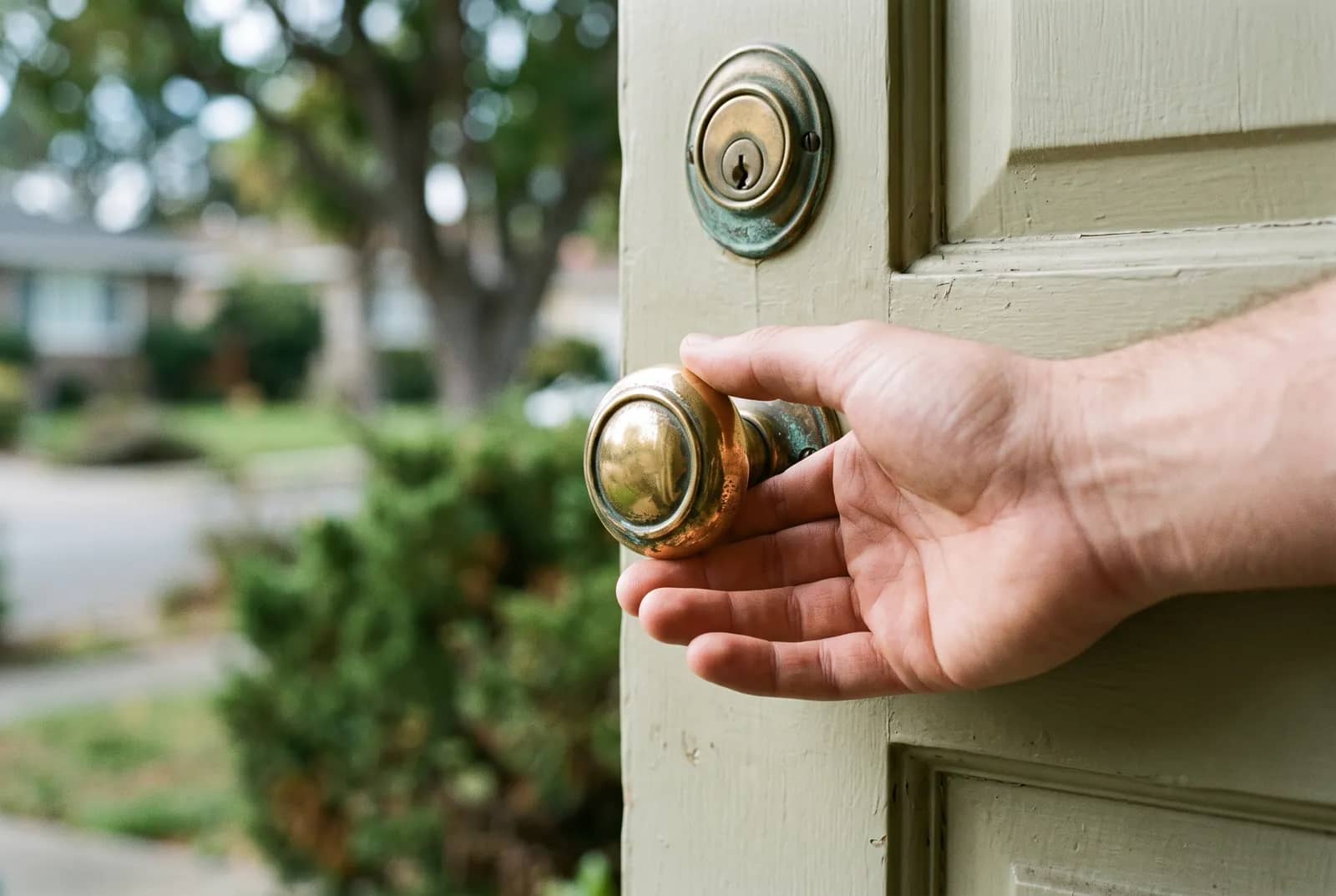
Bought once, for a whole tract
On a job that put up thousands of houses to a handful of plans, nothing was bought door by door. The hardware arrived in one order, in one finish, and went onto the doors in the order the doors were hung. That is why the knob on a 1952 house here is the same knob three streets over, and why a technician who has stripped one of them has effectively stripped three hundred.
What came with the house was a keyed knob on the front door, a plain passage knob on the door in from the garage, and often nothing at all on the door to the yard. Deadbolts were not part of the order. Where there is a deadbolt above the knob today, an owner added it in the seventies or eighties, and you can usually tell because the finish does not match and the bore is a slightly different size.
One thing worth saying plainly: we do not know which maker filled that order, and anybody who tells you otherwise on a website is guessing. The lock on your door will tell you itself — the name is stamped on the face, around the keyhole, on nearly every set of the period.
What is actually inside the knob
A brass plug with five pins in it, five springs above them, a spindle running through the door, a latch with a half-inch bevel, and a couple of set screws. That is the whole machine. Nothing about it is exotic and nothing about it is unobtainable — springs, spindles, set screws and latches for hardware of that period are still made, and a van that works these streets carries them.
Which is the argument for keeping it. Hardware from a 1950s builder order was made heavier than most of what the same money buys today, and the parts that fail are exactly the ones that can be changed with the set still on the door. Replacing a working knob because it is old is buying a lighter lock and losing the only thing in the house that matches the house.
The mileage, counted honestly
A door opened a dozen times a day for seventy years has turned something on the order of a quarter of a million times. That is the door at the back of the garage. The front door at the top of the outside steps, opened twice or three times a week, has done a small fraction of it.
This is why two locks of identical age in the same house are in completely different condition, and why the honest recommendation is so often split: keep the original set on the front door, where it is barely worn and where it is doing the least security work anyway, and replace the one downstairs, which has done the mileage of five ordinary front doors.
Add the air to the arithmetic. Seventy winters of marine fog through a vented garage does more to a spring than seventy years of turning does. On the ocean side of the city the corrosion sets the retirement date, not the wear.
Three checks, about a minute each
The key. Put it in slowly and watch it go. It should slide to the shoulder in one movement with no lift and no jiggle, and turn with two fingers. If it has to be drawn back a hair before it will turn, either the key has drifted or the plug has worn, and cutting a fresh key from the best original you own is by far the cheaper of the two to try first.
The latch. Open the door, press the latch in with your thumb, release it. A snap you can hear at arm's length is a healthy spring. A slow return is a tired one, and a tired one is what leaves a door standing closed but not latched on a windy night.
The jamb. Take one screw out of the strike plate and measure it. Three-quarters of an inch means the plate is holding into trim. Nothing else on this page changes a door as much as replacing those with three-inch screws that reach the framing, and it is a few minutes inside a visit rather than a purchase. While you are there, look for white or green bloom around the keyhole — that is the salt, and it means the inside is further along than the outside looks.
The point where it is finished
There are four honest ends. The plug has enough slop that a key from another house off the same order will turn it. The hub inside has rounded so no spindle drives it cleanly and the knob turns without the latch following. The case has cracked, usually where a screw was overtightened decades ago. Or the keyway has pitted so badly that even a freshly cut key binds on the second turn.
At that point it is a replacement at $125 to $329 fitted, and the fitting is where the money goes: the bore is often narrower than today's standard, the leaf has moved, and the strike pocket has to be re-cut so the new bolt lands in the middle of it. On an exterior door ask for the stainless finish rather than the chrome one, for the reasons set out in the salt guide.
Even then, there is a case for keeping the old knob on the inside face where it is seen every day and is doing no security work at all. It costs nothing to leave it there and it is the only original thing most of these houses have left at eye level.
What a rekey does, and what it does not
Rekeying puts new bottom pins into the cylinder you already own so that a fresh key works and every key cut before today stops working. It is $29 to $46 a cylinder, the second and third at the low end, and one $89 call-out covers the stop no matter how many cylinders are on the list. Nothing is bought and nothing on the face of the door changes.
What it does not do is upgrade anything. New pins in a plug that has done a quarter of a million turns give you a worn lock with a newer key, and a knob that could be turned with a screwdriver last week can still be turned with one. Rekeying settles who holds a working key. It settles nothing about the door, and on a house of this age the door is usually the part that is asking for attention.
Quick answers
Should the builder's original knob set stay on the door?+
Often, yes. It was made heavier than a same-price replacement today and the parts that fail — springs, spindles, set screws, latches — are changed with the set still on the door. It is replaced when the plug has slop, the hub has rounded or the case has cracked, at $125 to $329.
How can I tell what brand is on my door?+
Look at the face of the lock around the keyhole. The maker's name is stamped there on nearly every set of that period. We will not tell you what the builder ordered, because there is no source for it that we would stand behind.
The front door lock is fine but the garage one is rough. Why?+
Mileage. The door at the back of the garage takes a dozen cycles a day and the front door at the top of the steps takes two or three a week. Same age, same order, fifty times the work. Replacing one and rekeying the other is a normal outcome here.
Need it handled rather than read about?
(650) 977-1855