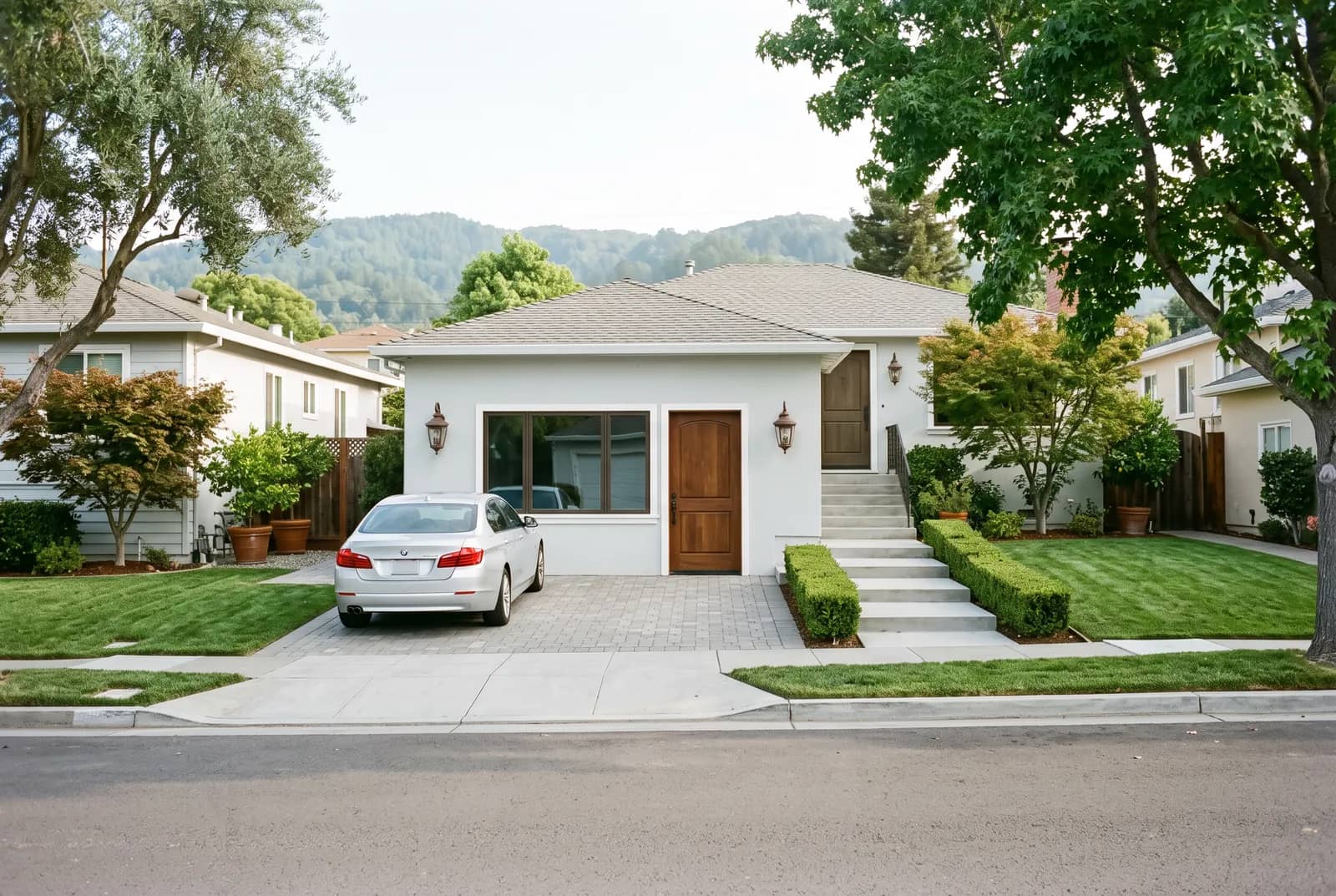
Why this keeps happening on these streets
The city permits a garage to be converted into a separate dwelling and does not require the parking space to be replaced somewhere else on the lot. On a hillside of twenty-five-foot lots where replacing a parking space is close to impossible, that one rule is the difference between a conversion happening and not happening.
The house plan cooperates as well. The living floor is already half a level up and self-contained, the garage already has its own entrance at pavement level, and the two are already separated by a door and a short flight of stairs. Very little has to be invented. What changes is the traffic: the lower door stops being the family's back door and becomes somebody else's front door.
Whether a particular conversion needs a permit, what it has to satisfy on egress and fire separation, and what the inspector will want are questions for the city and for the contractor. This guide is only about the keys, which is the part that is usually decided last and then lived with for years.
The decision that matters: how many keys exist
Scheme one, separate and simple. The flat has its own key and the house has its own key, and neither opens the other. This is the right default when the flat is let to somebody outside the family. It is also the cheapest: two rekeys at $29 to $46 a cylinder, done in one stop.
Scheme two, one key for everything. This only makes sense when the flat holds family and there is genuinely one household spread across two floors. It is tidy until somebody moves out, at which point every cylinder on the property has to change instead of one.
Scheme three, a master key system. The owner carries one key that opens both doors, the tenant carries a key that opens only the flat, and nothing has to be handed back and forth. It is the right answer for a property that will be let for years, and it is the one job on our price list that is quoted after a survey rather than from a range, because the answer depends on how many doors, gates and boxes end up on the plan.
The door between the flat and the house
This is the one people get wrong, and it is almost always still wearing the passage knob it had when the space was a garage. Once there are two households, that door is a boundary between two homes rather than an internal door, and it needs a real bolt in it.
Decide first which side holds the key, and say it out loud to everyone involved. What we will not fit on it is a deadbolt keyed on both faces. Either household might need to leave through that door in a hurry, and a bolt that needs a small key in the dark is not a way out. Where a door has to be secure from both sides, the answer is a bolt with a turn on the inside and a way to lock that turn when the place is empty.
The physical door matters as much as the lock. A hollow-core leaf that was fine when it separated a car from a kitchen is not doing anything now. A solid leaf with a one-inch bolt landing in a strike screwed through to framing is $125 to $329 fitted, and it is the single line on this page worth spending on.
Everything else on the property with a lock in it
The mailbox. A second dwelling usually means a second box, and the postal service has its own rules about who fits and holds the key for a mail receptacle. Ask before you cut anything. Meters, the crawl space hatch and the side gate all need to be reachable by the tenant without borrowing a key from the owner, or they will simply be left unlocked.
The roll-up door, where it survives. Where the garage has been converted, the big door is often fixed shut or gone, but the opener may still be live in the ceiling with a memory full of remotes. Clear it. On almost every opener made in the past thirty years there is a learn button on the motor head, held down until the light goes out, and every remote it has ever known is forgotten. Then pair only the remotes you can put your hands on.
And the outside stair to the front door. Where the flat has taken the pavement-level entrance, the household upstairs now uses those steps for everything, including at night with their arms full, which changes what that door needs. Light first, then the lock.
Turnover, which is the whole point of getting this right
A let flat changes hands. Every time it does, the flat's cylinders are rekeyed at $29 to $46 each with one $89 call-out for the stop, and the house upstairs is untouched. That is what scheme one and scheme three both buy you: a change that takes twenty minutes instead of an afternoon.
Where turnover is frequent, a keypad on the flat door at $189 to $479 earns its keep, because a code is retired in thirty seconds without anyone driving out. Two cautions particular to this city. The flat door faces the pavement and takes wind and fog, so it wants a shrouded, stainless-finish unit and a mechanical keyway kept live behind the cover. And the code on the door should not be the same four digits as the code on the opener keypad, which is a habit that spreads through a household in about a week.
Keep a written list of who holds what. Two doors, two keys and two people is easy to hold in your head. Two doors, two keys, a contractor, a cleaner and a tenant who has moved out is not, and a rekey is the only honest way to close that list once it has been lost.
Quick answers
Can the tenant's key and my house key be the same?+
It can be done, and it is only a good idea when the flat holds family. With a tenant outside the family, use two separate keys or a master key system, so that a change of tenant means one rekey at $29 to $46 a cylinder instead of the whole property.
What goes on the door between the flat and the house?+
A solid leaf and a single-cylinder deadbolt, $125 to $329 fitted, with a turn on the side that must be able to leave in a hurry. We do not fit a bolt keyed on both faces there, because that turns a way out into a locked door.
How much is a master key system for a house with a flat under it?+
It is quoted after a survey rather than from a range, because the figure depends on how many doors, gates and boxes end up in the plan. The $89 call-out sits inside whatever figure comes back, the same as on every other job here.
Need it handled rather than read about?
(650) 977-1855