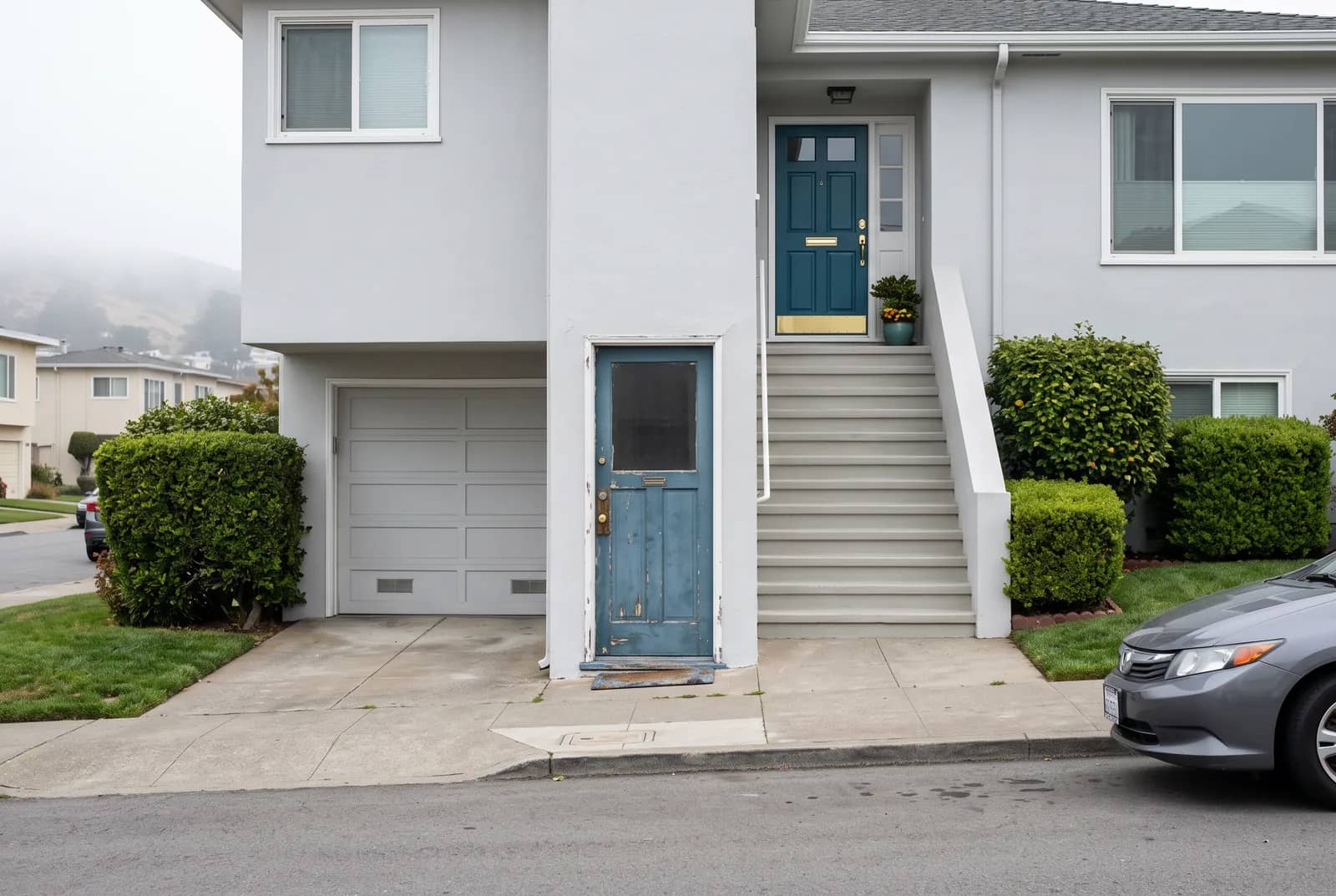
One plan, one hillside, thousands of the same house
Between 1948 and 1962 a single developer bought around 1,350 acres of ranch land west of Mission Street and filled it with houses drawn to a short list of plans — some eleven thousand of them across two counties by the time he stopped. Stand on almost any Westlake street and the same cross-section repeats down the block: a single-car garage opening straight onto the pavement, the living floor half a level above it, and a flight of outside steps climbing to a front door.
The lots are twenty-five to thirty feet wide. There is no side yard to walk down, no back path, no second way in from the street. Whatever comes to the house — people, groceries, tools, the dog — comes in through the garage and then through a second door at the back of it.
For anyone who works on locks that repetition is useful. Give the street and the year and the door is largely known before the van moves off: same leaf thickness, same stile width, same tired half-inch strike screws, and a bore drilled for the knob set of the period rather than for anything sold today.
Which door the household actually uses
Do the arithmetic on a household of about three people, which is roughly what these three-bedroom, eleven-hundred to fourteen-hundred square foot houses hold. Each person leaves and comes back at least once a day. That is a dozen or so cycles a day through the door at the back of the garage, every day, for as long as the family has lived there.
The front door at the top of the steps gets the mail carrier, a delivery, a visitor at the weekend. Two or three turns a week, sometimes fewer. Two doors of exactly the same age, in the same house, bought in the same order, and one of them has done fifty times the work of the other.
Then the awkward part. On most of these houses the busy door carries the cheapest hardware on the property — a passage knob, or a builder's keyed knob with no deadbolt above it — because when the house was new the roll-up door was treated as the lock and the door behind it as a formality. The most-used door in the house has the least on it. That is the whole of the problem, and everything below follows from it.
What wears, in the order it wears
The latch spring goes first. It is the thinnest piece of steel in the assembly and it is being compressed a dozen times a day. When it tires, the latch stops snapping back out and starts easing out, and a door that looks shut is resting against the strike instead of latched into it.
The plug goes next, slowly. Brass turning inside brass, a hundred thousand times, with a key that is itself a copy of a copy. Long before it fails outright it starts asking to be jiggled, then lifted, then persuaded. Meanwhile the hinge screws — three-quarters of an inch long, into a jamb that is trim nailed to framing — let the leaf drop a few millimeters, and the bolt stops meeting the middle of the strike.
All of that happens faster here than it would two miles inland, because a garage is vented by design. Fog comes in under the roll-up door and sits around the hardware, and it carries salt with it. The door at the back of the garage lives outdoors in every way except the rain, which is the subject of its own guide on this site.
Two checks worth doing while you are standing in the garage
First, open that door wide and push the latch in with your thumb, then let go. It should come back out with a snap you can hear from arm's length. If it creeps out, or needs help, the spring is done and the door is not latching when you think it is.
Second, if there is a deadbolt, throw it with the thumb turn while the leaf hangs free in the air, then shut the door and throw it again. Free in the air and stiff when closed means the fault is alignment, not the lock. Around half the calls that come in here as broken locks are strike-and-hinge work: this city runs from sea level to about 780 feet, the ground under parts of it moves, and frames move with it.
While you are there, back one screw out of the strike plate and look at its length. Three-quarters of an inch means the plate is fastened to trim and nothing else. Three-inch screws that reach the framing behind the jamb are the cheapest useful change on the whole property and they are part of a visit rather than a purchase.
What we fit down there, and what it costs
Rekeying is $29 to $46 per cylinder, with the second and third at the low end because the van is already at the curb and one $89 call-out covers the whole stop however many cylinders are on the list. That is the right answer when the hardware is sound and the question is only who holds a working key.
Where the door has only a latch on it, a deadbolt fitted properly is $125 to $329, and on a garage-level door the fitting is most of the value: the leaf gets brought back up on long screws, the strike pocket is cut deep enough for the bolt to throw its full inch into solid wood, and the finish is chosen for the air it will live in. Builders order BHMA 626, satin chrome over brass, which is an indoor finish. A mile from open water the door wants 630, satin stainless.
A keypad or smart lock is $189 to $479, and this is the one place where the lower door beats the front door outright. It stands inside the garage, out of the wind and out of the sun, which is exactly the shelter that electronics on an exposed stair-top front door never get. Fit it there, keep a mechanical keyway, and have the key cut and tested before the van leaves.
If you are standing outside that door right now
A house lockout is $129 to $239 with the $89 call-out already counted inside the figure. Between 8pm and midnight the figure carries $50, and between midnight and 7am it carries $90, both said on the phone rather than found on the receipt. The average arrival across the city is 18 minutes and Westlake is nearer than that, usually about 12.
Ninety days on the workmanship, and here that covers the door as well as the lock. If the leaf was planed or the strike was moved to make your key turn, that is workmanship like any other and it is written on the receipt with the part maker's own term beside it.
Quick answers
Should the deadbolt go on the front door or on the garage door?+
On the garage door first, if you only do one. It is the door the household uses a dozen times a day and it is usually the one carrying a plain knob. Fitted, that is $125 to $329, and the fitting includes long hinge screws and a re-cut strike.
The door from the garage into the house has only a knob. Does that matter?+
Yes, and it is the commonest finding on these streets. A passage knob holds a door shut, not closed. A deadbolt with a full one-inch bolt landing in a strike screwed through to framing is the change that does the most for the least on a house of this age.
How long does it take to reach Westlake?+
About 12 minutes from the base near Westlake Center on a normal day, against an 18 minute average across the city. St. Francis Heights is about 14 and Westlake Knolls about 15. The figure is said on the call together with the price.
Need it handled rather than read about?
(650) 977-1855