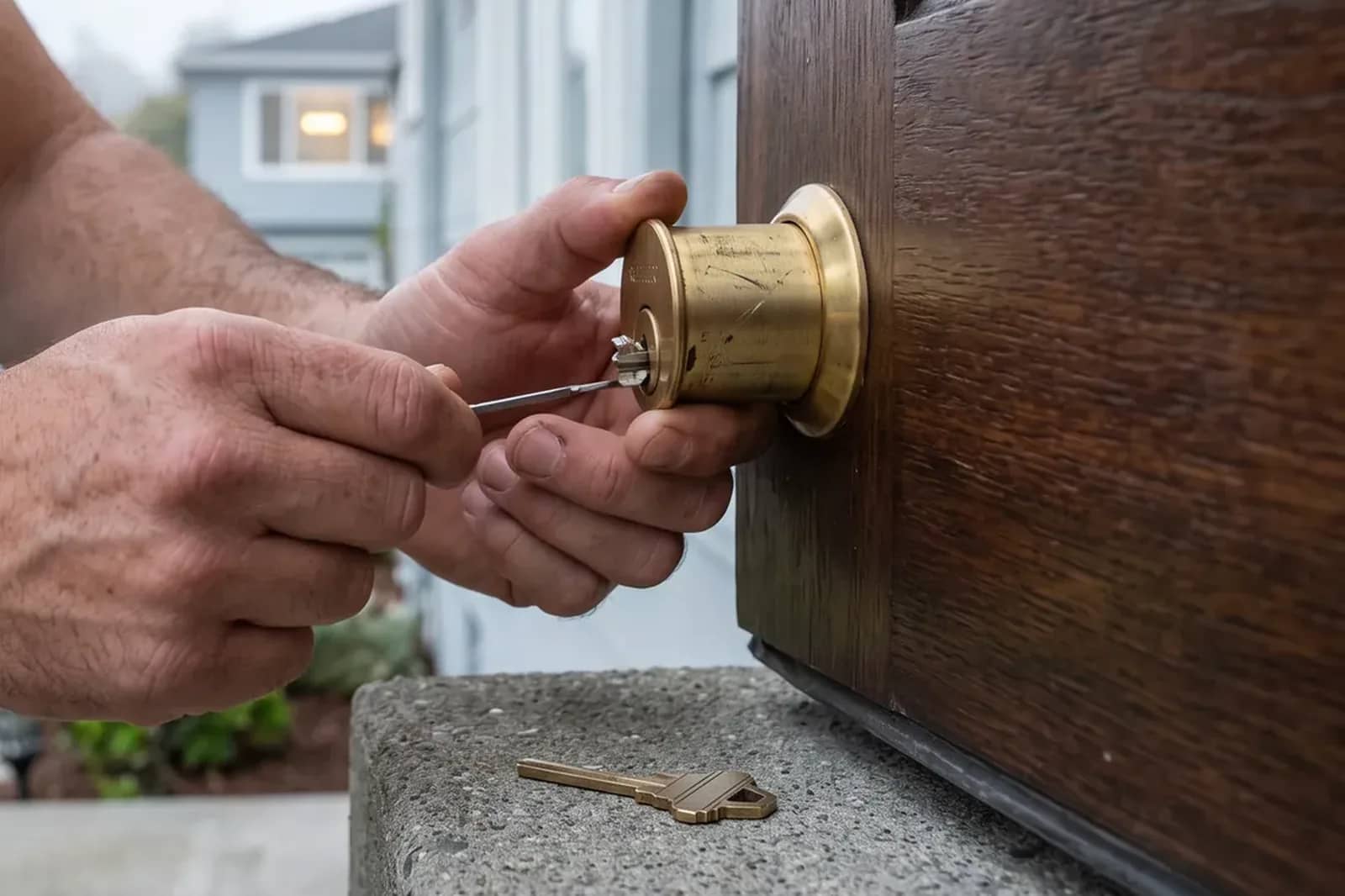
Why keys break here rather than somewhere else
Three things line up on these streets. The key is brass and is usually a copy of a copy, so it is both softer and slightly wrong. The cylinder has salt in it and is stiffer than it was a year ago. And the door has moved on its hinges, so the bolt is rubbing the strike and the key is taking that load as well.
The key is the softest thing in that chain, so the key is what gives way. It almost never happens without warning. There is normally a fortnight of a lock that needs a wiggle, then a lift, then a shove, and the morning it breaks is simply the morning somebody was in a hurry.
The first thirty seconds decide the price
Stop. Do not try the other half. Do not turn what is left of the plug in either direction. That single instruction is worth more than everything else on this page.
Here is why. If the plug is still sitting where it was, the keyway is a straight slot and the broken piece is lined up with the opening, which is exactly what an extractor needs. If the plug has been rotated with the fragment inside it, the fragment is now held past the shear line by the pins and there is no straight path out. The first case is often a few minutes at the door. The second frequently ends as a replacement cylinder.
If the door is standing open, leave it open. If it is shut and bolted, say so when you call, because it changes which tools come off the shelf before the van leaves.
What not to do while you wait
Pliers, if the stub is flush or nearly flush. What they actually do is push the fragment deeper and burr the edges so that it grips the walls of the keyway. Where a good centimeter is standing proud, gentle straight traction with fine pliers is fair enough — but straight out, with no twisting, and if it does not move on the second try, stop.
Glue, in any form. It is the single most expensive thing anyone does to a lock in this city. It bonds the fragment to the plug and to the pins, and it turns a five-minute extraction into a replacement at $125 to $329. The same goes for chewing gum, tape wound onto a matchstick, and every other version of the idea.
A screwdriver in the keyway, which rounds the hub and finishes the lock. The spare key jammed in on top of the fragment, which drives it home. And oil sprayed in and then forced, which floats the fragment further in and leaves a film to be cleaned out afterward. Drilling is a last resort even for us, and it is never the first thing tried.
What genuinely helps
Keep the half in your hand and put it somewhere you will not lose it. If it is the bow half of an original key rather than a worn copy, it is a better pattern for a new key than anything else in the house, and it can save a cut.
Take a photo down the keyway with the phone light on. It shows whether the fragment stands proud, how far the plug has been turned, and whether the keyway is one of the older profiles, all of which can be answered before anyone arrives.
Then use another door and let it be. On a house of this plan there is nearly always a second way in — the door at the top of the outside steps, or the one from the garage — and a lock that is left alone for twenty minutes is a cheaper lock than one that has been worked on.
What happens at the door
A pair of extractors goes in beside the fragment, hooks the cuts and draws it out along the keyway. Then the more useful part: finding out why it broke. A cylinder that snapped a key is stiff for a reason, and putting a fresh key into the same stiff cylinder buys about a month.
Most of the time that means a clean-out and a rekey at $29 to $46 a cylinder with a key cut and tested on the door, both sides, before anyone drives away. Where the plug is pitted or the keyway has corroded, it is a replacement at $125 to $329 with the stainless finish rather than the chrome one. Where the leaf has dropped and the bolt is binding, the hinges and the strike are put right in the same visit, and that is covered by the ninety-day workmanship warranty like anything else.
If you are locked out of the house entirely, that is $129 to $239 with the $89 call-out already inside the figure, $50 more between 8pm and midnight and $90 more between midnight and 7am, all of it said on the phone.
If it broke in the car
Do not turn the ignition further and do not try the spare on top of it. A key that snaps in an ignition normally has a worn wafer set behind it that has been fighting the key for months. Ignition repair is $185 to $459, and a replacement key cut and programmed at the car is $155 to $419 depending on what the car wants.
If the break was in the door lock and you cannot get in at all, a car lockout is $105 to $199. Car door cylinders in this city seize quietly because nobody has used them since the fob worked, which is worth knowing before the fob battery dies in a BART parking structure at eleven at night.
Quick answers
Can I get the broken piece out myself?+
Only if a good centimeter is standing proud of the face. Then fine pliers, straight out, no twisting, and stop after the second attempt. If it is flush, leave it. Pliers on a flush stub push it deeper and burr it, which is what turns an extraction into a new cylinder.
Will superglue on a matchstick work?+
No, and it is the most expensive thing you can do to the lock. The glue bonds the fragment to the plug and the pins, and a job that would have been an extraction and a $29 to $46 rekey becomes a replacement at $125 to $329.
Does the lock always have to be replaced after this?+
No. Most are extracted, cleaned out, rekeyed and given a fresh cut key, provided the plug was not turned with the fragment inside. Replacement is for a plug that is pitted or a keyway that has corroded past the point where a new key will run cleanly.
Need it handled rather than read about?
(650) 977-1855